Approved and Rejected Solid Icons: A Versatile Design Solution
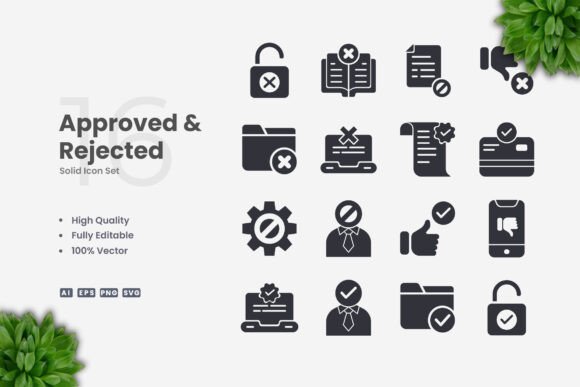
Approved and Rejected Solid Icons are a powerful set of design elements that offer clarity, consistency, and adaptability across various platforms. Whether you're working on a website, mobile app, or print material, these icons provide a straightforward way to convey approval or rejection in a visually appealing manner. Their clean and simple design makes them ideal for a wide range of applications, from digital interfaces to physical marketing materials.
Understanding Approved and Rejected Solid Icons
Approved and Rejected Solid Icons are part of a broader category of iconography that uses solid shapes and minimal details to communicate specific meanings. These icons typically feature bold lines, clear forms, and a consistent visual language that ensures they are easily recognizable at any size. The design is intentionally kept simple to avoid distractions, making it easier for users to focus on the message being conveyed.
These icons are often used in contexts where quick decision-making is required, such as in user interfaces, feedback systems, or status indicators. For example, an approved icon might be used to indicate a successful transaction, while a rejected icon could signal an error or failure. This direct communication helps users understand the outcome of their actions without needing additional text or explanation.
Key Features of Approved and Rejected Solid Icons
- High Quality Design: Each icon is crafted with precision to ensure sharpness and clarity, even when scaled up or down.
- 100 Vector Format: The icons are available in vector format, allowing for seamless resizing without loss of quality.
- 100 Customizable: Users can easily modify colors, sizes, and other attributes using vector editing software like Adobe Illustrator or CorelDRAW.
- Easy Drag and Drop: The files are designed for quick integration into design projects, saving time and effort during the development process.
- Source Files Included: Access to AI, EPS, SVG, and PNG formats ensures compatibility with a wide range of design tools and platforms.
- Readme.txt Guide: A detailed guide is provided to help users navigate the file structure and understand how to use each icon effectively.
Where to Use Approved and Rejected Solid Icons
The versatility of Approved and Rejected Solid Icons makes them suitable for a variety of applications. Here are some common use cases:
- Websites: These icons can be used in form submissions, user dashboards, or interactive elements to provide instant feedback.
- Mobile Apps: They enhance the user experience by offering visual cues for success or failure within an app's interface.
- Books and Infographics: In printed materials, these icons add a professional touch and help convey complex information more clearly.
- Social Media: When used in posts or graphics, they make content more engaging and informative.
- Flyers and Banners: These icons can be incorporated into promotional materials to highlight key messages or outcomes.
- Posters and Print Materials: Their clean design ensures they remain legible and impactful in any setting.
Who Benefits from Using Approved and Rejected Solid Icons?
Approved and Rejected Solid Icons are beneficial for a wide range of users, including:
- Web Developers: They can quickly integrate these icons into their projects, improving both functionality and aesthetics.
- Graphic Designers: The customizable nature of the icons allows for greater creative flexibility and consistency in design work.
- Business Owners: These icons can enhance marketing materials, customer communications, and internal processes with clear visual signals.
- Content Creators: From bloggers to YouTubers, these icons add visual interest and improve the overall presentation of digital content.
- Students and Educators: In educational materials, they help illustrate concepts related to approvals, rejections, and decision-making.
Strengths and Considerations
One of the main strengths of Approved and Rejected Solid Icons is their simplicity. The clean design ensures that they are easy to understand and adaptable to different contexts. Additionally, their high-quality vector format allows for easy modification and scalability, making them a practical choice for designers and developers alike.
However, there are some considerations to keep in mind. While the icons are highly customizable, users may need to have some familiarity with design software to make changes effectively. Additionally, the lack of a mockup preview means that users will need to rely on their own design skills to visualize how the icons will look in their final project.
Real-World Applications
Approved and Rejected Solid Icons have been successfully used in a variety of real-world scenarios. For instance, an e-commerce platform might use an approved icon to indicate a successful checkout, while a rejected icon could show a payment failure. In a mobile app, these icons can be used to provide instant feedback after a user completes a task or encounters an issue.
In the context of social media, these icons can be used in infographics to represent survey results, user engagement metrics, or content performance. They can also be included in email templates to indicate whether a message has been delivered or if there was an error in sending.
Evaluating Suitability for Your Needs
When considering whether Approved and Rejected Solid Icons are right for your project, it's important to assess your specific requirements. Ask yourself questions such as: What is the primary purpose of the icon? Will it be used in a digital or print format? Do I have the necessary design tools to customize the icons?
If you're looking for a reliable and flexible solution that can be adapted to multiple platforms, these icons are a strong choice. However, if you're working on a project that requires a more detailed or stylized design, you may need to explore other options.
Ultimately, Approved and Rejected Solid Icons offer a practical and effective way to communicate approval and rejection through visual design. Their simplicity, quality, and versatility make them a valuable resource for anyone involved in design, development, or content creation. Whether you're working on a small project or a large-scale initiative, these icons can help enhance the clarity and impact of your work.