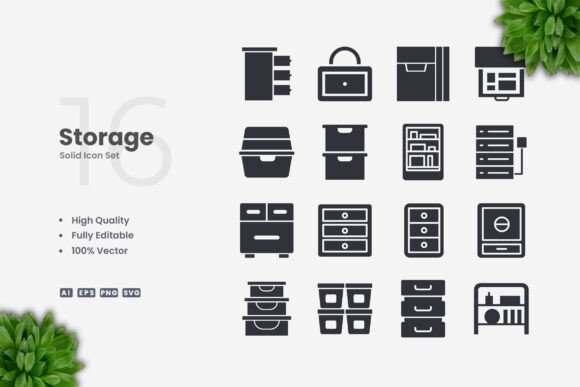
Storage Solid Icons for Streamlined Design Workflows
Storage Solid Icons offer a versatile and professional solution for designers, developers, and creators looking to enhance visual communication across multiple platforms. These icons are designed with simplicity and clarity in mind, making them ideal for integration into websites, mobile apps, books, social media content, infographics, flyers, print materials, banners, posters, and more. Their clean aesthetic ensures they remain relevant and adaptable in a wide range of design projects.
The core value of Storage Solid Icons lies in their ability to support efficient workflows. Whether you're working on a digital product, marketing campaign, or editorial layout, these icons provide a consistent visual language that aligns with modern design standards. Their high-quality vector format allows for seamless scaling without loss of detail, ensuring sharpness at any size.
How Storage Solid Icons Fit Into Your Workflow
Storage Solid Icons can be used at various stages of a project. Before starting a design, they help establish a visual identity and ensure consistency across assets. During the development phase, they streamline the process of adding graphical elements to interfaces, reducing the need for custom illustrations. After the project is complete, they contribute to long-term maintenance by offering a reliable set of icons that can be easily updated or modified as needed.
For example, when designing a website, Storage Solid Icons can be incorporated into navigation menus, buttons, and interactive elements. Their simple shapes and solid fills make them easy to recognize, even at smaller sizes. This makes them particularly useful for mobile app interfaces where space is limited and clarity is essential.
Customization and Compatibility
One of the standout features of Storage Solid Icons is their 100% customization potential. Designed as vector files, they can be edited using software like Adobe Illustrator and CorelDRAW, allowing users to adjust colors, sizes, and shapes to match specific brand guidelines or design requirements. This flexibility ensures that the icons can adapt to different contexts without losing their visual integrity.
The file formats included—such as AI, EPS, SVG, and PNG—provide compatibility across various platforms and tools. For instance, SVG files are ideal for web use, offering scalability and small file sizes, while PNGs with transparent backgrounds are perfect for print and digital media. The inclusion of a Readme.txt file further simplifies the setup process, guiding users through the available files and their intended uses.
Practical Implementation Tips
To get the most out of Storage Solid Icons, consider the following tips:
- Plan your icon usage early: Define which icons will be needed for each project to avoid last-minute adjustments.
- Use a consistent color scheme: Apply a unified palette across all icons to maintain visual harmony.
- Test icons at different sizes: Ensure readability and clarity at both small and large scales.
- Organize your assets: Store icons in clearly labeled folders to streamline access during design sessions.
- Update as needed: Keep your icon library current by replacing outdated designs with newer versions.
Integration With Other Tools and Resources
Storage Solid Icons work well alongside other design resources and tools. They can be paired with typography kits, UI kits, and branding guidelines to create cohesive visual systems. When used in conjunction with design platforms like Figma, Sketch, or Adobe XD, they enhance the efficiency of prototyping and user interface development.
For teams, these icons promote consistency across projects by providing a shared resource that aligns with company standards. This reduces the need for individual design efforts and ensures that all deliverables maintain a professional appearance.
Efficiency and Long-Term Use
Investing in a high-quality icon set like Storage Solid Icons can improve long-term productivity. By reducing the time spent on creating or sourcing icons, designers and developers can focus on more complex tasks. The ease of editing and reusing these icons also supports iterative design processes, where changes and refinements are made over time.
Additionally, the reliability of vector files ensures that icons remain usable across different devices and screen resolutions. This future-proof approach minimizes the risk of obsolescence and maintains the relevance of design assets over time.
Real-World Use Cases
Storage Solid Icons are suitable for a wide range of applications. For instance, a small business owner might use them in a website redesign to create a modern and professional look. A marketer could incorporate them into social media posts to highlight key messages or features. An educator might use them in infographics to illustrate concepts in a clear and engaging way.
In publishing, these icons can be used to break up text and add visual interest to articles, reports, or e-books. For print materials such as brochures or posters, their high-resolution PNG files ensure crisp and clean output, even when printed at larger sizes.
Quality Control and Consistency
Maintaining quality and consistency is crucial when using any design asset. Storage Solid Icons are created with attention to detail, ensuring that each icon adheres to a uniform style. This consistency helps prevent visual clutter and reinforces the overall message of a design.
Before finalizing a project, it's advisable to review all icon placements and ensure they align with the intended purpose. Testing the icons in real-world scenarios—such as on different devices or in varying lighting conditions—can reveal any issues that need addressing.
Conclusion
Storage Solid Icons provide a practical and efficient solution for designers and creators across multiple industries. Their clean, customizable design makes them an excellent addition to any workflow, supporting both short-term projects and long-term brand strategies. By integrating these icons into your design process, you can enhance visual communication, improve consistency, and streamline your creative efforts.